Can you build a product without a team? Where AI helps — and where it doesn't
- AI
- development


Until recently, building a website was considered a complex and expensive process. You had to find a team, explain your idea, wait for the design, frontend, backend, and then go through endless revisions.
Today, you can open Claude, Codex, or another AI tool, describe your idea, and within minutes get a website structure, interface mockups, and even working code.
AI can help build landing pages, online stores, CRMs, internal dashboards, and many other web products. But there's an important limitation: while AI dramatically lowers the barrier to development, it doesn't replace product thinking, testing, or engineering expertise.
Let's look at what AI can realistically do, where it delivers the most value, and when experienced specialists are still essential.
How AI is used in website development
AI now supports almost every stage of product development. One of its most common uses is generating website structures and user interfaces.
For example, you can describe a task like this: "I need an e-commerce website for a premium fashion brand with a product catalog, shopping cart, and user account."
Within seconds, AI can suggest the page structure, write placeholder copy, create interface concepts, and even generate the visual part of the website.
This is especially valuable in the early stages of a project. When an idea is still evolving, few companies want to invest tens of thousands of dollars in full-scale development. Instead, you can build a working prototype in a single evening and immediately see how the product feels.
AI is also becoming increasingly capable of generating interface elements, including buttons, forms, product cards, mobile-friendly layouts, and basic animations. Many simple websites can now be assembled with very little manual coding.
Modern AI tools can automatically generate:
- landing page structure;
- content for the website;
- visual design elements;
- basic frontend code and animations;
- cross-device layouts.
A good example is one of our CEO Andrey's side projects, where everything — from research to interface animations — was created with the help of AI.
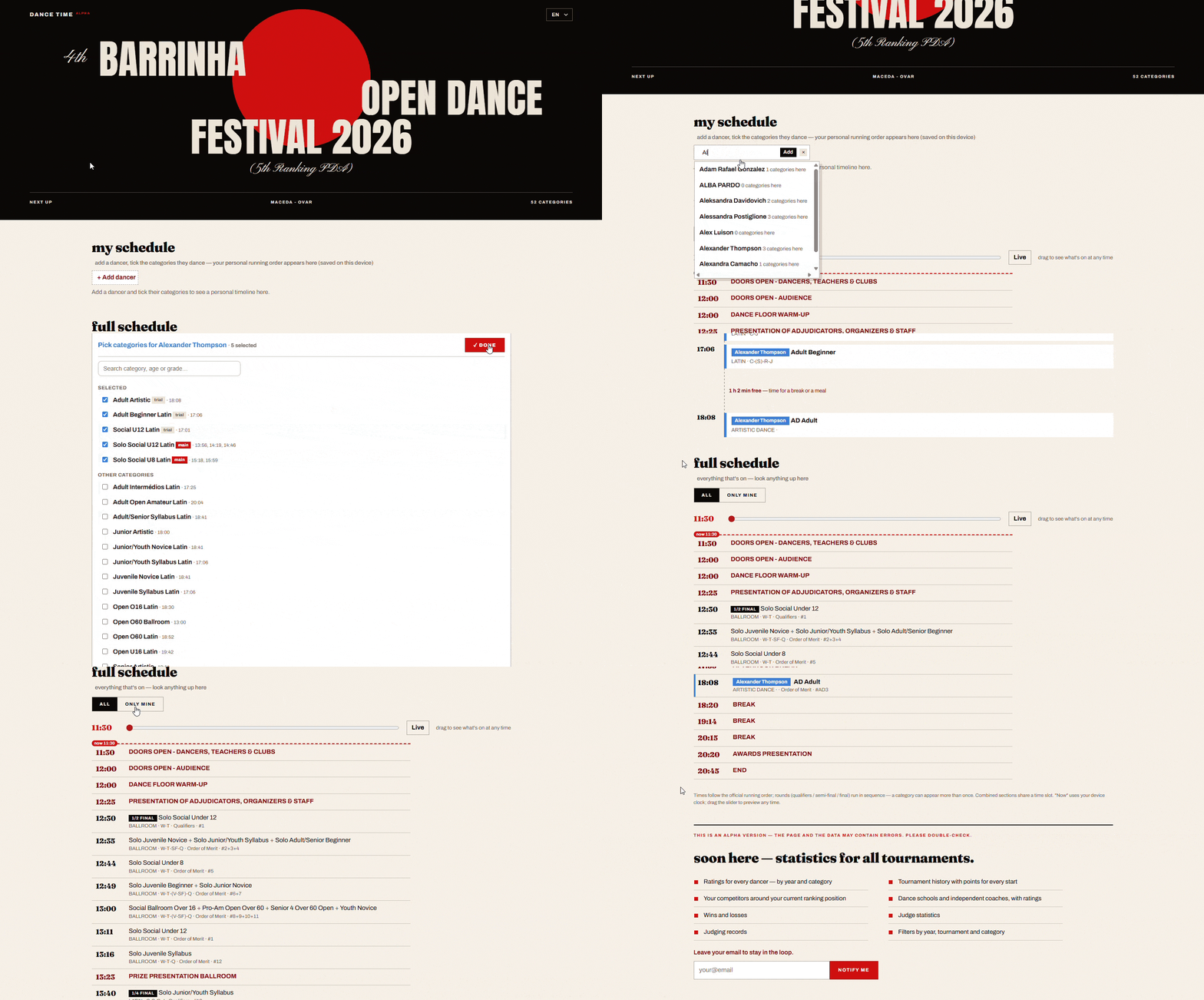
The same applies to web services. Can AI build a web application? For basic products, absolutely.
Internal CRMs, management systems, and operational tools that once required expensive custom development can now be built in just one or two sprints by specialists who know how to work effectively with AI.
What AI is best at
AI performs best on relatively straightforward projects, such as:
- landing pages;
- promotional websites;
- simple e-commerce stores;
- internal business tools;
- admin panels;
- MVPs;
- interfaces for validating product ideas.
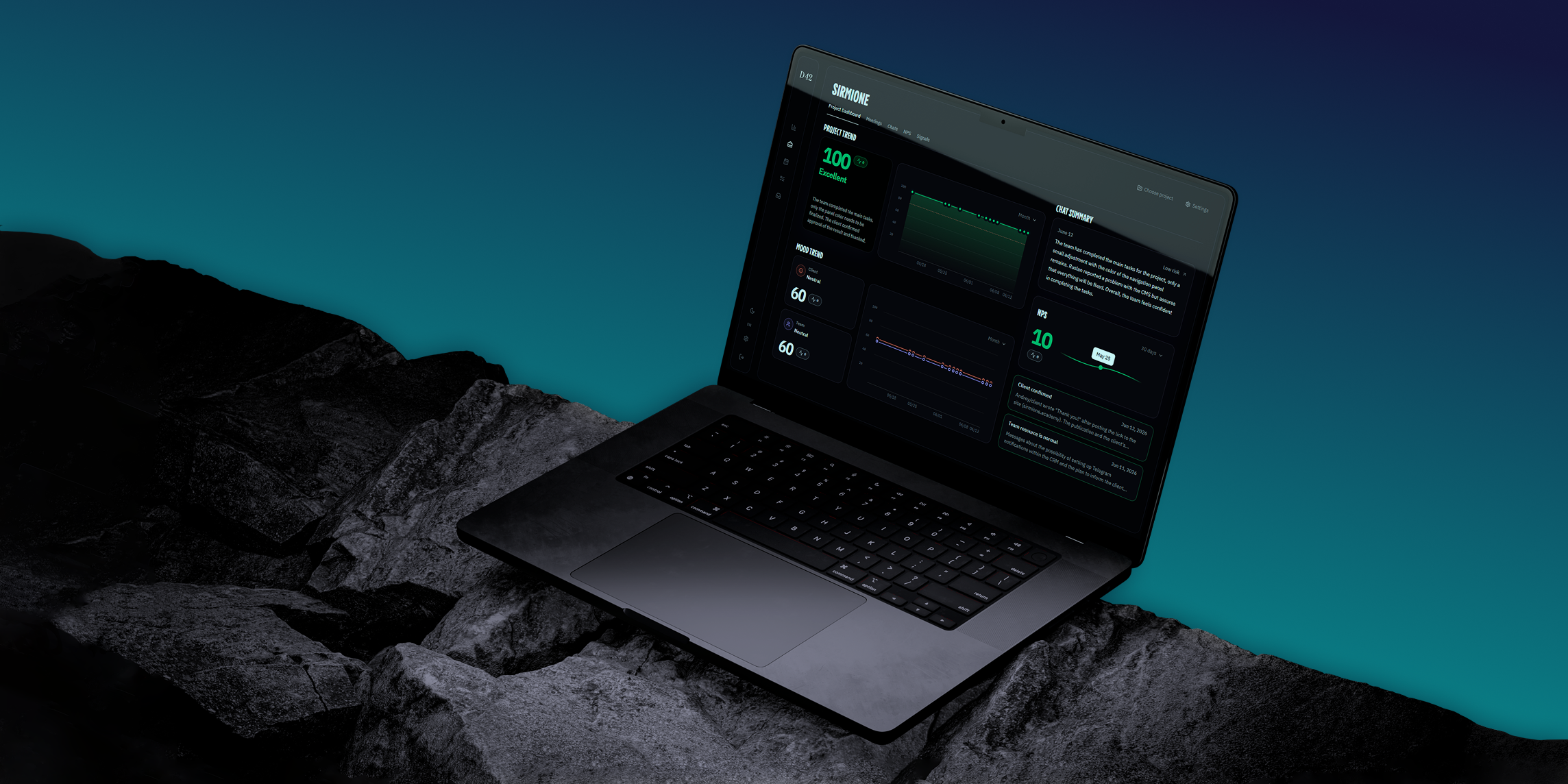
A good example is Depot 42 Signal, our internal project monitoring platform. Signal helps teams identify risks early, including employee burnout, unhappy clients, and potential delivery delays.

We built the MVP in just seven days without a dedicated designer or development team. AI helped us prototype user flows, generate interfaces, and implement the initial logic. But AI alone didn't create the product. It simply accelerated execution. The real value came from product expertise and decision-making.
Read also
Depot 42 Signal — how we built an AI radar for projects in 7 days
Speed is where AI delivers its greatest advantage. Launching even a basic product used to require finding contractors, writing detailed specifications, and waiting months for delivery. Today, you can describe your requirements to AI and receive a working first version within a day. It won't be perfect, but it's usually good enough to validate a hypothesis.
This naturally raises the question: Can you build a website with AI if you're not a developer? For relatively simple projects, the answer is often yes — especially if you already understand what the final product should accomplish.
However, it's important to remember that AI generally produces average solutions. They're an excellent starting point, but rarely become exceptional products on their own.
If your interface needs to reflect real user behavior, business processes, and complex workflows, experienced product designers and developers remain indispensable.
Advantages of using AI
The biggest advantage is speed. Tasks that previously required weeks can now be completed within a day – or sometimes even in minutes. If you need a landing page, AI can generate a solid foundation in fifteen minutes, leaving you free to refine the details. For businesses, this translates into significant time savings.
Accessibility is another major benefit. You no longer need a large team or a substantial budget just to test an idea. A simple prototype can be built with minimal investment, allowing you to determine whether the concept deserves further development.
That's why startups and small businesses increasingly ask whether AI can build websites. It significantly reduces the cost of testing new ideas.

Read also
AI in development: how to move faster without turning your product into a stack of hacks
Another major advantage is rapid iteration. Within a few hours, you can test multiple page structures, interface styles, or content variations. Previously, this level of experimentation required considerably more time and resources.
AI is also highly effective at eliminating repetitive work:
- researching and organizing information;
- generating boilerplate code;
- assembling UI components;
- drafting content;
- creating initial screen layouts.
However, successful results depend less on pressing a "Generate" button and more on giving AI clear, well-structured instructions. AI accelerates execution — but it doesn't replace product thinking or professional expertise.
Limitations of AI
Despite its strengths, AI still struggles with complex software projects. It can generate attractive interfaces, but the underlying code may contain architectural flaws, duplicated logic, or security vulnerabilities.
On a small website, these issues may be manageable. On a large-scale platform, they can become serious technical debt.
An AI model may generate clean, working code today and produce something completely unusable tomorrow for a nearly identical prompt. This is why expert review remains essential.
AI also struggles with sophisticated business logic — particularly in products involving payment systems, API integrations, high-load infrastructure, or highly customized workflows. For example, we actively use AI while developing the EVEDEX cryptocurrency exchange. It significantly accelerates research, prototyping, design, and development, but the critical architectural decisions remain in the hands of experienced specialists.

Another limitation is the lack of genuine product thinking. AI doesn't understand business goals or strategic context the way humans do. Instead, it recombines existing patterns, which doesn't always produce the best user experience.
So, can AI build a website? Yes.Can it build a scalable, high-quality digital product entirely on its own? Not yet.
When you still need developers
There comes a point where AI reaches its limits and software engineering begins.
If your project includes:
- complex business logic;
- multiple third-party integrations;
- sophisticated permission systems;
- high traffic;
- internal operational workflows;
- strict security requirements
– AI alone is no longer enough.
The more ambitious the product becomes, the more important an experienced development team is. Professional engineers don't just write code. They design scalable architectures, validate AI-generated solutions, and ensure the product remains reliable as it grows.
A good example comes from design. In our Freedom Football Manager project, AI generated several interface concepts for a player evaluation system. None of those concepts were used directly in the final product, but they inspired the direction that ultimately led to the right solution.

The same principle applies to scaling. AI can help you build version one remarkably quickly, but as the product grows, infrastructure, stability, performance, maintainability, and long-term support become engineering challenges.
Conclusion
AI isn't replacing software development — it's transforming it. Modern product teams use AI to generate code, create interfaces, validate ideas, and automate repetitive work. But the most important decisions are still made by people.
Today, the strongest products are built not instead of a team, but together with AI.
Read more

AI in development: how to move faster without turning your product into a stack of hacks
- development
- AI

AI can already write code and design interfaces. So what’s left for humans?
- AI
- product design
Our projects


Digital product development
for scalable web and mobile products. UI/UX design, development, and end-to-end delivery
Let’s talk
By clicking the button I agree to the Privacy Policy
Message sent
We'll get back to you soon